|
|
The value of our services far exceeds the cost.
| Odessa, TX | Phone (432) 580-8061 | Fax: (432) 580-0547 |
| Hobbs, NM | Phone: (575) 397-1069 | Fax: (575) 393-5836 |

Welcome to Cardinal Surveys Company's Home Page. Our intent is to construct a web site that will be useful to any petroleum professional in the oil and gas industry who is interested in production logs, injection profiles, radioactive tracers, radiation safety, and after stimulation logs. You will find information on preparation, general procedures, safety, and regulatory concerns.
This site was designed to be compatible with both Netscape Navigator and Microsoft Explorer, and now Mozella Firefox. Graphics have been kept as small and simple as possible to reduce dead time at our site.
Velocity Calculator - Convert BPD to Linear Velocity!
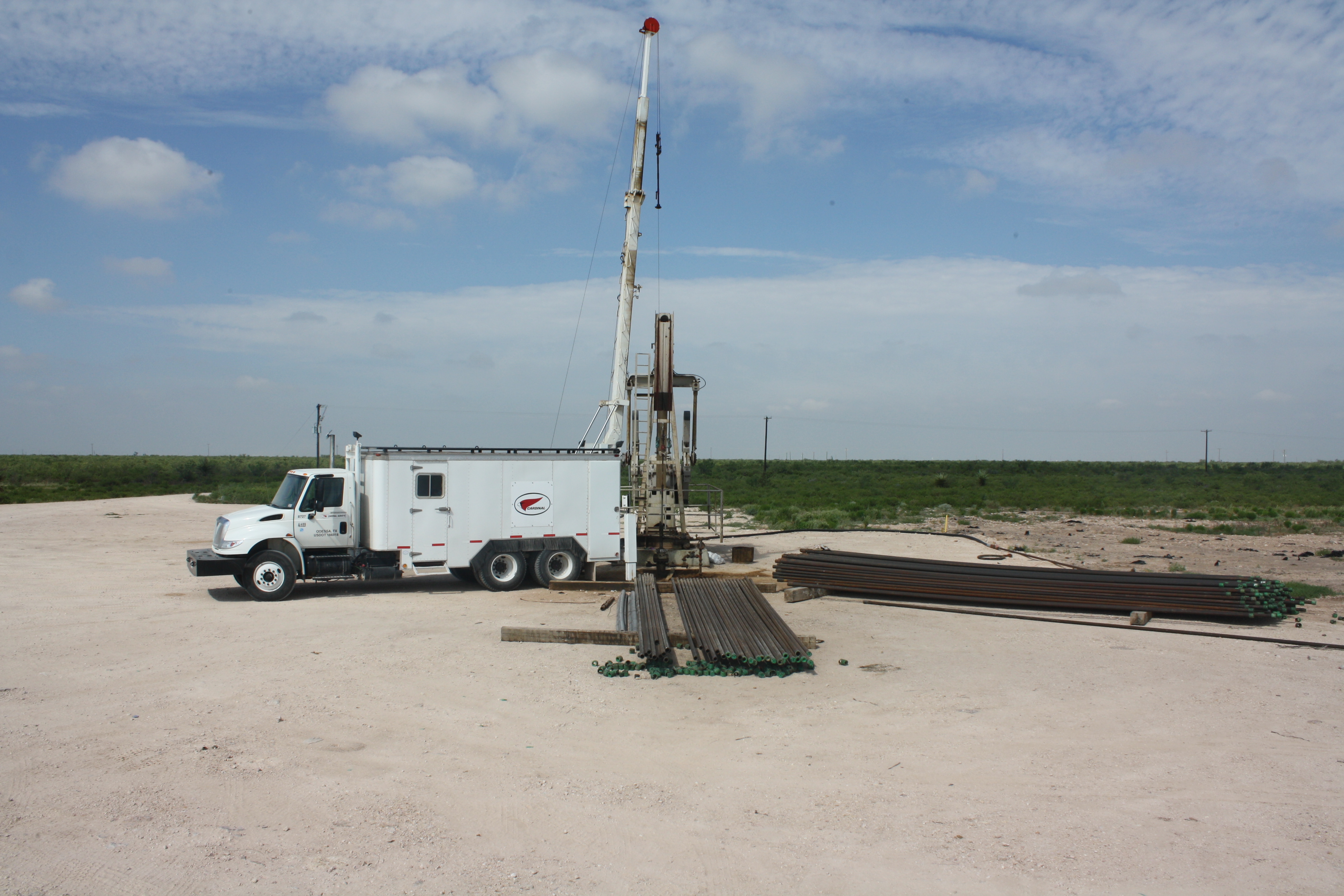
Wolfberry and
unconventional production
logs: Zone-by-zone breakdown of production in wells
on rod pump artificial lift, even small casing sizes. 4 1/2" casing with 2
3/8" tubing have been successfully logged. Don't make guesses or
assumptions about your well, use the best available technology to scientifically
determine your well's performance. See link
above, Annulus Trac-III.
Cardinal Surveys
Company Safety Policies and Manuals
New Service
We are proud to announce a new Log Archive Service. Every finished log is now stored in PDF, and LAS format
in Cardinal's Log Archive server located @ www.cardinallogarchive.com.

Find your log in the Cloud! Contact a Cardinal Surveys sales representative for a user name and password to access your data.
Webex
Web conferencing - we can meet with you personally on your desktop! Go over your logs, discuss and evaluate in real time. We simply arrange an appointment, and meet you virtually in your office or anywhere you have internet access. We can share any document with you electronically, and can include up to 25 of your associates, each from their physical location, anywhere in the world.
Downloads
Multi-channel gamma spectrum logging. Recognizes scandium, antimony, and iridium used to trace stimulation fluids. May be run in conjunction with temperature logs. Merged and analyzed data available in field immediately after logging passes are completed. Tool size: 1 ¼ in. May be run as soon as stimulation treatment is completed. New, improved analysis algorithm and simplified telemetry.
 Production logs of coalbed methane (CBM) gas
producers.
The Annulus Trac III log is used to identify the actual productive zones,
and verify downhole mechanical configuration. In a recent application, 10
wells were logged using the exclusive 7/8"
O. D. logging tools. Modification of the down-hole configuration of one
well paid for the cost of logging all 10 wells in less than one month!
Further workovers are planned to increase
production for the lease based on the diagnostic results from the Trac III logs.
If you expect a continuing firming in the natural gas market place,
now is the time to diagnose and plan workovers for coal-seam wells!
Cardinal Surveys has more experience in logging
coalbed methane wells while under actual producing conditions than anyone in the
World.
Production logs of coalbed methane (CBM) gas
producers.
The Annulus Trac III log is used to identify the actual productive zones,
and verify downhole mechanical configuration. In a recent application, 10
wells were logged using the exclusive 7/8"
O. D. logging tools. Modification of the down-hole configuration of one
well paid for the cost of logging all 10 wells in less than one month!
Further workovers are planned to increase
production for the lease based on the diagnostic results from the Trac III logs.
If you expect a continuing firming in the natural gas market place,
now is the time to diagnose and plan workovers for coal-seam wells!
Cardinal Surveys has more experience in logging
coalbed methane wells while under actual producing conditions than anyone in the
World.Food for Thought on Technology...
When NASA first started sending up astronauts, they quickly discovered that ballpoint pens would not work in zero gravity. To combat the problem, NASA scientists spent a decade and $12 billion to develop a pen that writes in zero gravity, upside down, underwater, on almost any surface including glass and at temperatures ranging from below freezing to 300 Celsius.
The Russians used a pencil.
Insanity in individuals is something rare - but in groups, parties, nations and epochs, it is the rule.
- Friedrich Nietzsche (1844 - 1900)
Insanity: doing the same thing over and over again and expecting different results.
- Albert Einstein, (attributed) (1879 - 1955)
 Metric
Conversion ChartHe has the Knack! Literature (Adobe .PDF
Format) and Powerpoint!
Metric
Conversion ChartHe has the Knack! Literature (Adobe .PDF
Format) and Powerpoint!Look in the GLOSSARY for any definitions you may need.
Check out the Cool Links Page.
A little humor from Steven Wright.
More humor from Yogi Berra.
William Shakespeare, "Hamlet", Act 3 scene 4
Search the World Wide Web using the BEST search engine we know of:
visits since August 1, 1998.
(Wow!)

 Site designed
by Burl Wylie
Site Hosted By:
Site designed
by Burl Wylie
Site Hosted By: